

Gamifiied Skiing

Two years ago, for the holidays, I accidentally unleashed a monster when I gave Alex Carv sensors and a season’s pass. The combination of being an excellent skier and ultra competitive at, well, everything, manifested into a Ski:IQ craving obsession. I saw the glimmer in her eye as she unwrapped the Carv box and figured out what they were. Immediate question: “What is the max Ski:IQ1 and how do I get it?”
What’s a Carv?
Carvs, for those not in the know, are dual L and R sensors that clip to the power straps at the top of your ski boots.
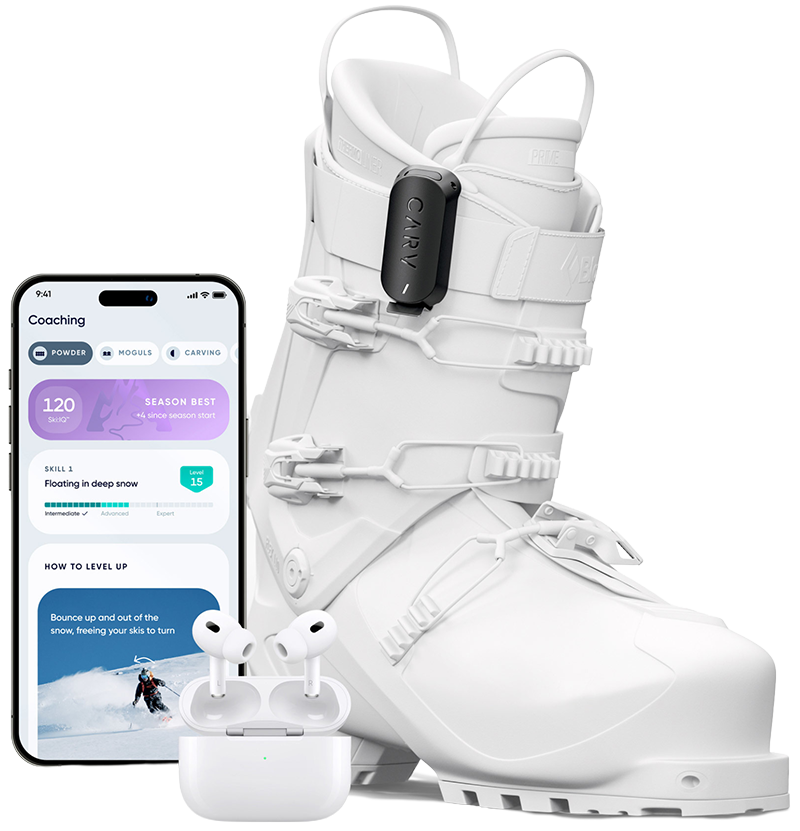
They’re really a wild array of sensors squeezed around a battery, and can measure every facet of your skiing performance from parallel skis to edge angle to weight release to what feels like a hundred more things you’re probably doing wrong. The Carv app on your phone connects by Bluetooth and records every minute detail.
Carv AI
There’s a lot of AI that goes into turning a ski turn into useful coaching. It starts the minute the sensors turn on and figure out which direction they’re facing and where they got attached to the boots, and goes all the way through the analysis of the thousands of data points that turn your motion into a Ski:IQ score and personalized, real-time audio coaching that plays in your ear as you ride the next chairlift back to the top. Here’s the Carv team explaining how they re-engineered the original Carv 1, which had an awkward footbed sensor in the boots, to the Carv 2 sensors that snap on the outside:
Alex and I spent many 2024/25 chairlift rides laughing at the terrible robot Carv voice giving her coaching (imagine a badly robot filtered voice saying “Picture trampolines at 45° all the way down the hill and bounce back-and-forth between them”). This year’s Carv app got a significant upgrade in the user experience, the algorithm, and the voices, which now sound like real humans.
Do you even Carv, bruh?
I joined Alex in the Carv club this year, which is how I know my personal-best Ski:IQ for the season is 121, and I need to work on early edge angle and simultaneous edging.
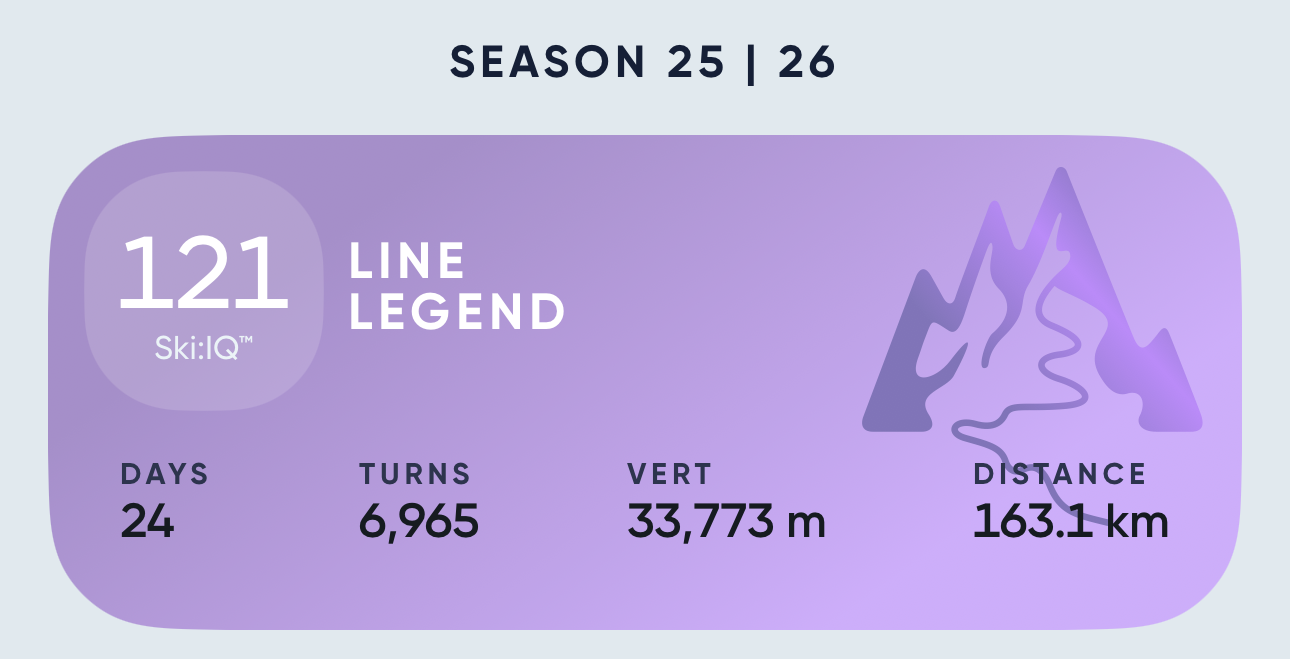
Carv has a fun name for each level, which are 10 Ski:IQ points apart. Alex is a Mountain Master in the 140s, Grim Rippers are in the 150s, and Shred Zepplins are in the 160s. The highest level is Mountain Goats in the 170s.
George Flynn, Carv Pro, finished the 26/27 season at the top of the global leaderboard with a 185, necessitating the creation of a whole new level (the top nine global skiers were 180+). His twin brother Bart finished second at 183. Nature vs. nurture? You decide.
So, what separates the Flynns from the Goldmans of the world? Aside, of course, from a lifetime of skiing, living in Jackson Hole, being on the PSIA-AASI National Team, much lower knee/back mileage, and 60 or so Ski:IQ points. Let’s dig into what a season of Carv taught me.
What makes good gamification?
Gamification has been widely studied and applied in many fields, building on what makes games of all kinds so compelling. Wikipedia says:
Gamification is the process of integrating game design elements and principles into non-game contexts. The goal is to increase user engagement and motivation through the use of game elements such as points, badges, leaderboards, and more. It is a component of system design. Gamification has been used to improve organizational productivity, flow, learning, crowdsourcing, knowledge retention, employee recruitment and evaluation, usability, usefulness of systems, physical exercise, tailored interactions and icebreaker activities in dating apps, traffic violations, voter apathy, public attitudes about alternative energy, and more.
There’s a core set of principles that make the approaches truly effective at influencing our highly malleable human brains, including, for our Carv context, four main ones:
- Tight feedback loops anchored to clear goals. Games never leave you wondering what to do next or whether you’re making progress. Experience Point (XP) bars fill visibly, hit indicators fire on impact, and quest markers persist. Goals have variable time horizons (what should I do in the next 30 seconds, during this game session, over the long arc of the story), and the best systems make those different goals visible.
- Progressive mastery curves. Easy to learn, hard to master, and difficulty that scales with the player’s actual skill. New mechanics are introduced gradually, and later content builds on earlier competence. Flow state lives in the narrow band between competence and challenge, and that band moves as we get better at doing things. The best systems adapt how hard they push you so that they’re always at that right balance point.
- Layered rewards (fixed and variable). The best video games also find a balance between variable rewards (loot boxes full of power-ups hidden throughout the game, slot machines that dispense them but vary how much you get) and fixed rewards (finish this task and get a reward). The games that hold people for years and become true classics (Diablo, World of Warcraft, Halo, Call of Duty) layer both: you reliably get something meaningful when you finish a level, and you sometimes get something extraordinary. Fixed rewards build trust; variable rewards build anticipation.
- Social context/Community. Leaderboards, guilds/clubs that players form organically, and shared quests/missions. Even single-player games have communities. Status (visible achievement to peers), cooperation (shared goals), and competition (comparison) all compound engagement. To be truly effective, they have to be designed in, not bolted on, which is often the case in enterprise gamification. Toxic comparisons and hollow leaderboards are the tumbleweeds blowing through many (if not most) attempts to slap gamification concepts onto enterprise software rollouts and change management.
Gamifying the slopes
Carv is built on many generations of highly effective gamification concepts from video games, designed to engage your competitive drive and push your skiing forward. Here’s one example (of very, very many) to show how deep the whole system is and where the AI really helps you improve.
Carv breaks down your different types of skiing: parallel, carving, short turns, moguls, and powder. It logs every eight-turn segment by the type of condition and skiing you’re doing, switching automatically as you make your way down a run. We don’t get much powder or moguls in our regular season2, so my score is more accurate on the first three. I finished the season at 115 Ski:IQ in parallel, 120 in carving, and 121 in short turns3.
Each of those has a learning pathway in the Carv app, and you can switch the coaching to focus on whichever area you want to strengthen. For example, the first skill in short turns is tightening your turns, which I’m currently at level 16 on (a little past halfway through advanced, on my way to expert). This skill is measured in:
- Turn corridor: width of your turns from apex to apex, including turning radius and turn shape, measured in meters.
- Turn closure: how much your skis turn across the slope before starting a new turn. 100% is 180° of rotation.
- Turn tempo: the cadence of turns per minute.
There are five other skills in the short turn pathway, including steering with your legs, creating more grip, keeping your skis in sync, rebounding between turns, and taking on steeper terrain. Each breaks down into a set of measurements, which translates into specific coaching. Lots of video tutorials are available for every skill, like this:
They’ve also got a full encyclopedia worth of training on their own website and in the Carv app, like How to Improve Your Short Turns, from whence that video came.
If you’ve spent any time playing video games, you’ll see how this maps perfectly to things like skill trees and level bosses. Let’s run it through our four gamification mechanisms:
- It’s a tight feedback loop anchored to a clear goal: I might get audio coaching on the chairlift ride to focus on one aspect of tightening my turns on the next run. I’ll hear a good or bad turn noise on every turn, and then I’ll get a Ski:IQ audio score at the bottom of the run, accompanied by any level-up notifications (“You just passed level 17 on tightening your turns!”).
- Getting to mastery on one will automatically shift the focus area to the next, which will start off easy and get harder in a progressive mastery curve.
- Variable rewards are probably the weakest gamification area, because everything you do is directly connected to fixed rewards rather than anything being variable. Good turns trigger a happy sound, bad turns make a sad one. A great run sets a new day and season best Ski:IQ scores, and progressing through levels gives you the reward of leveling up. Variable rewards are a more powerful motivator than fixed ones because they’re unpredictable. BF Skinner’s research in the 1950s
Is it all worth it?
That’s the real question — and the one we get asked the most often by other skiers. Nothing about skiing is cheap, and Carv is no exception. Ski lessons are really pricey, but you can’t beat the coaching from a real human who knows what they’re doing. An annual Carv Season Pass costs about what two in-person one-on-one coaching sessions run. The coaching isn’t as good, but it’s constant every time I do a run, and you can always combine it with some real coaching.
I’ll never be a pro skier, but I do get a lot of enjoyment out of skiing. Carv made me a better skier last season, and I expect it’ll do the same next season. For me, that’s worth the price of entry. For some of the folks we ski with, who are at a level I’ll probably never reach, Carv isn’t worth it. Their competitive natures kick in, making them want to beat their personal bests and ski at an intense level beyond what’s comfortable. Their opportunity for improvement starts off so much lower than mine, so their Carv points-to-subscription-dollar ratio just doesn’t check out. The answer for you probably lies in where you fall along that spectrum.
Footnotes
-
Yes, she pronounced the colon. ↩
-
My soul says it’s sad about the lack of powder; my aging knees say they’re happy about the lack of moguls. ↩
-
Funny story — I got a single score of 107 in moguls because we did a ski race camp over the holidays, and we had to do one run of super short turns around some stubby posts, which Carv decided was me flailing at moguls. ↩
Subscribe to JayGoldman.com
Get an email when I publish. Pick a stream — or everything. Unsubscribe anytime.