
Toronto Tech Week 2026

Toronto Tech Week 2026 wrapped up recently and there’s a real feeling of engagement and momentum in this city. It’s a little like it felt back in 2007 when we were running DemoCamp on the regular and the builders and creators were all getting together to share their stories and inspire each other. Hard to believe it’s been nearly 20 years! For those who don’t know the DemoCamp scene, or who miss it, Here’s a great recap from Ben Vinegar, who was there back in the day.
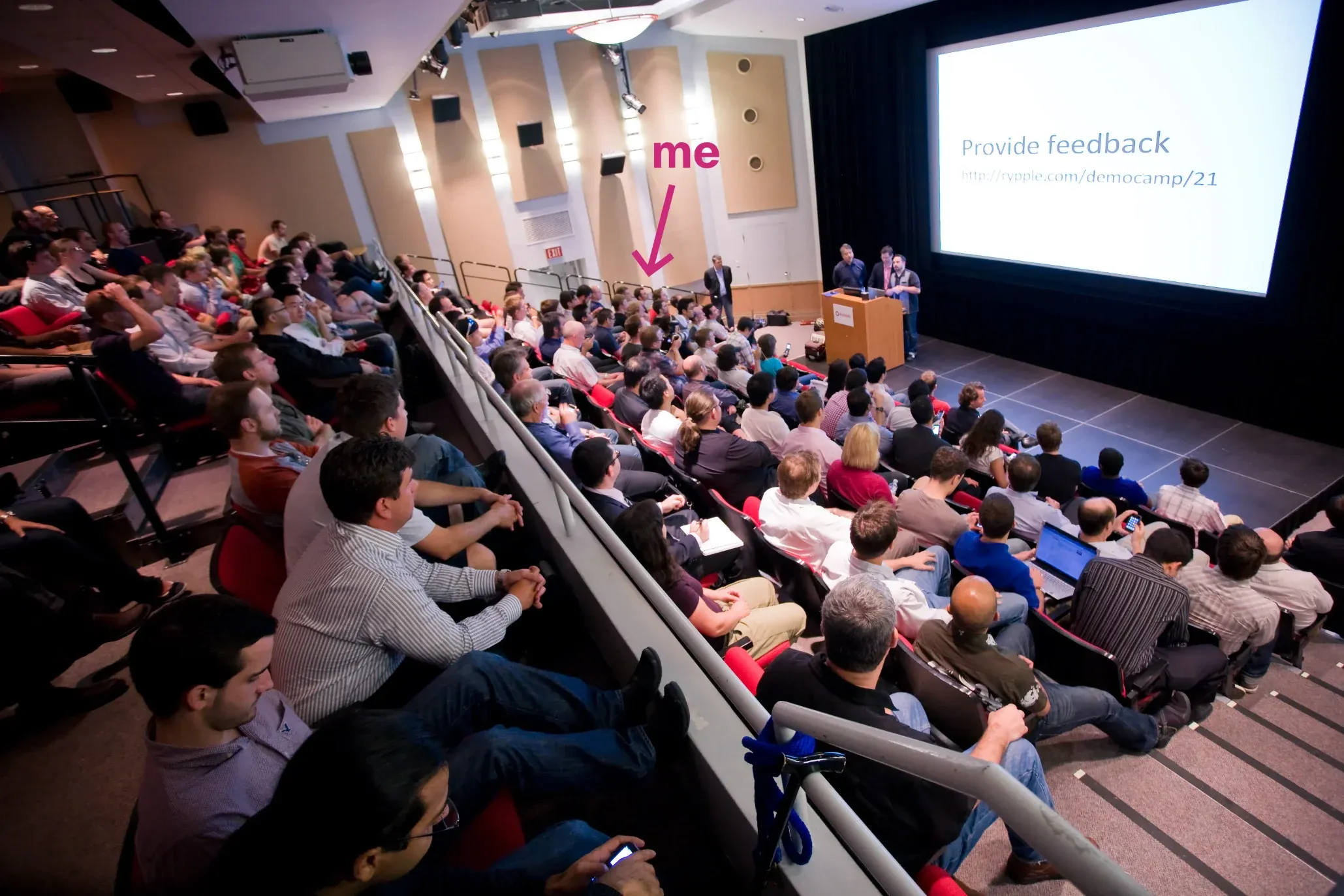 The arrow “me” is Ben, the actual me is at the podium at the front of the room — this was in my Rypple days, hence the Rypple feedback request on the screen
Back then, there was a lot of talk about being “Silicon Valley North” and about recreating the magic happening elsewhere. I never agreed with that. That’s their magic — we should make our own. And we are!
There’s a vibrant tech scene here that organized 600+ events for TTW, from the headlining Homecoming with guest speakers including Shopify’s Tobi Lütke in conversation with Rostra’s Lulu Cheng Meservey, Uber’s Andrew Macdonald, Cohere’s (and Good Kid rockstar) Nick Frosst, and Rebel’s Emily Hosie, to tiny events for every niche subgroup you could think of.
In addition to Homecoming, I had the chance to attend a few events, including a great scale stage founder dinner by my friends Catherine and Mark Graham from Commonsku, 2-Person Unicorn?, and Shopify Tech Talks. Global headlines that don’t bear recounting here have become a rallying cry for Canadians and I heard many a “true north strong and free” cry from stages and cocktail parties across the city all week long. I’ll echo my old friend Satish’s welcoming remarks from Homecoming — it would have been unthinkable to pack History with 900 entrepreneurs and founders a few years ago. Now is the time to build.
My TTW2026 takeaways
Revenge of the Atoms
There’s a real shift happening between the traditional SaaS founders, who were on top of the world two years ago, and the founders working on harder, often physical-world problems. Most of the tech industry is built on the idea that bits are better businesses than atoms, at least since the first dotcom boom (and likely well before that). Suddenly, threatened by waves of AI slop and vibe-coded apps, the pure play software leaders are looking nervous (myself included), while the people building in the atom world are celebrating their moats. Solving really hard, real-world problems with hardware used to be so much more difficult, capital expensive, time-consuming, and margin devouring. Now it just might be the thing that keeps those businesses from being left squashed in the path of the AI machine1.
A Universe of Decicorns
Many, many conversations, both onstage and off, about when we’ll see the first one- or two-person unicorn2 (including the aptly named panel discussion linked above). I might be becoming an old greybeard humbug, but I think it’s entirely the wrong question. A solo or duo founder team doesn’t need a unicorn. The right question: when will we see hundreds of those companies creating $10m in ARR at 80% margins, with a cost profile of a couple of laptops and some Claude Max accounts? We need a universe of new ‘decicorns’3. Take the independence, bootstrap all day, and keep the $8m+ a year in free cash flow. Building any company is difficult enough. Finding the very rare unicorn opportunities that can get to a billion is almost infinitely harder. The world needs some of them, to be sure, but shrug off the main character syndrome and welcome the idea that you can be very personally and materially successful on a far easier path.
Upside-downing the System
The entire system is built around companies raising piles of cash and then swinging for the fences so that the proverbial 1 in 10 can hit the home run that pays for the rest.
Investors are sitting on unprecedented dry powder (with much more on the way from the reopening of the IPO window). They need to deploy it to keep their LPs happy, which means they need investable businesses to put it in, which means it’s important that the system keeps the belief that tech startups need venture capital alive. It feels inevitable like gravity, but don’t forget that this is all invented from successive generations of human heads, and that all of it is highly mutable in a way the laws of physics aren’t. I always try to go back to first principles: the goal isn’t to raise lots of money, but rather to build great, highly profitable companies that return value to their shareholders.
I had a few chats with young entrepreneurs who have solid, growing businesses and are debating raising a round. None of them could articulate why they needed it, but it seemed like “the right thing to do”. We’ve mythologized fundraising as a hallmark of entrepreneurship, and they’ve attracted interested investors, so why not take advantage? More than one person told me they just need to say the word ‘AI’ and there’s enough blood in the water to raise a competitive round. The FOMO is strong.
I feel empathy for the investors. Imagine, for a moment, that you’re an early-stage VC. You raised a nice fund two years ago, bought a sweet Patagonia vest, and are out looking for deals. The entire economy of your industry has since gone completely upside down, and now you have teams of one or two founders who have built entire apps themselves, have almost no expenses, and are seeing real revenue faster than almost any growth curve in history. You need to place bets on an assumed five(ish) year hold period so that you can return capital to your LPs on schedule. You’re being squeezed between a very real rock — companies need less capital than ever — and an equally real hard place — the rate of change has accelerated so much that five year bets are near impossible to make.
There are definitely investable businesses out there. Not everything can be a small team, especially on the enterprise side where sales still requires relationships and high-touch. If you’re not running that playbook, then my advice, for whatever it’s worth: keep as much equity as you possibly can for as long as you possibly can. Stay scrappy, build something great, and only take on cash when your rocket ship is ready to lift off, you just need to buy the fuel, and you can’t afford it yourself.
The Dumbmaxxing Era
Of all the AI-pilled things I can’t wait to hear the end of, tokenmaxxing has got to take the Claude cake. For those not in the know:
Token maxxing or tokenmaxxing (also token maxing) is a metric used in an attempt to track productivity in the workplace, especially for those using artificial intelligence (AI) based services. AI services charge for each token, which represents units of effort expended by an AI service to solve a problem. Some believe that token consumption equates to productivity and thus can be used as a metric to monitor an employee’s work. (Wikipedia)
Some people might also believe that measuring a race car driver’s work is possible by looking at how much fuel they burn. Those people are wrong.
Drucker never said “what gets measured gets managed,” but V F Ridgway did, way back in 1956, in a paper titled Dysfunctional Consequences of Performance Measurements. The quote gets misattributed and misused all the time. The actual quote is:
What gets measured gets managed - even when it’s pointless to measure and manage it, and even if it harms the purpose of the organization to do so.
Token burn is a very poor proxy for good AI engineering. You can very inefficiently burn billions of tokens and accomplish nothing. You could set out to top a tokenmaxxing leaderboard your employer created just so they’ll stop pressuring you (cough, Amazon, cough). Perhaps, knowing that VCs are using token burn as an evaluation metric, you might go out of your way to crank up the flames and shovel your runway right on into that fire just to get their attention.
If I were an investor, I would look for companies that are clearly on the AI bus and achieving great things with the lowest token burn. Who would you rather back — the founders who are capital efficient and obsessed with sustainable growth, or the ones ready to feed your investment straight into the bonfire at the heart of the circular economy?
Footnotes
-
At least until the robots get here. ↩
-
For those not deeply steeped in the tech/venture capital world, a “unicorn” is a company valued in a funding round at more than a billion dollars. ↩
-
I asked Claude for the right prefix for something that’s 1/10th of something else — deca is 10x, deci is 1/10th — assume a $10m ARR business with 80%+ margins would command a 10x multiple. ↩
Subscribe to JayGoldman.com
Get an email when I publish. Pick a stream — or everything. Unsubscribe anytime.